6. Best Practices
Best Practices
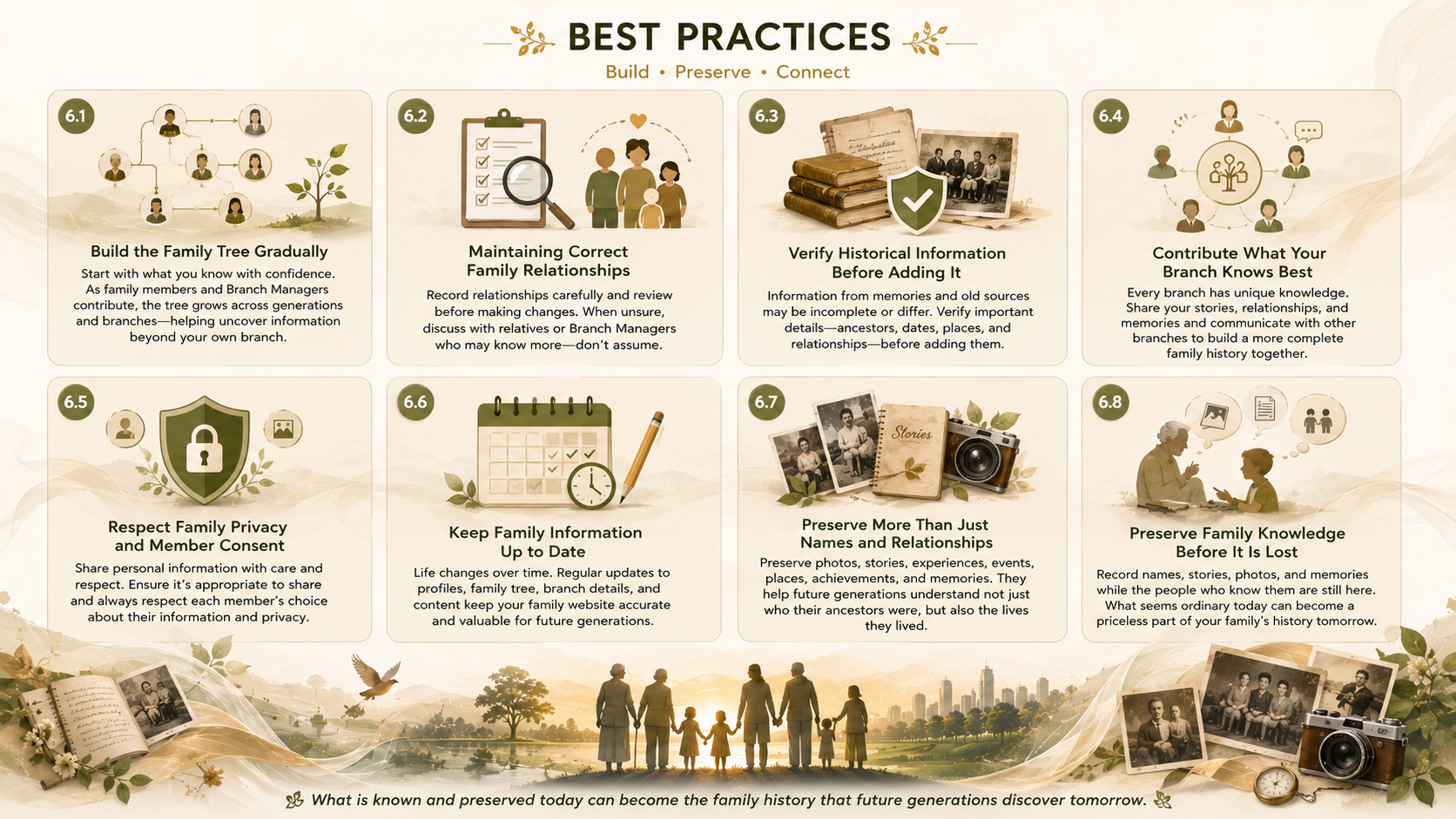
1 Build the Family Tree Gradually
Start with the people, relationships, and information that the family already knows with confidence. There is no need to complete the entire Family Tree at once. As different family members and Branch Managers contribute what they know, the tree can gradually grow across generations and branches. Building it this way also helps discover information that may not be known within one branch.
2 Maintaining Correct Family Relationships
The accuracy of the Family Tree depends on correctly recording relationships between family members. Take care when adding parents, children, spouses, and siblings, and review the existing relationships before making changes. When there is uncertainty, discuss it with relatives or other Branch Managers who may have better knowledge of that part of the family rather than making assumptions.
3 Verify Historical Information Before Adding It
Family history often comes from memories, conversations, old documents, photographs, and stories passed down through generations. Some information may be incomplete or different from what another relative remembers. Whenever possible, discuss and verify important historical information before adding it, especially information about ancestors, dates, places, and relationships between distant branches.
4 Contribute What Your Branch Knows Best
Every branch may have information that is unknown to other parts of the family. Branch Managers and family members should contribute the stories, relationships, memories, and other information they know best and communicate with other branches when their knowledge can help complete the Family Tree. This collective approach allows separate contributions to come together into a more complete family history.
5 Respect Family Privacy and Member Consent
A family website contains information about real people, including living family members. Personal details, photographs, contact information, life events, and other information should be shared with appropriate consideration for the person's privacy and consent. Before making personal information publicly visible, ensure that it is appropriate to share and respect the member's choice about what information they want to make available.
6 Keep Family Information Up to Date
Family information continues to change as people are born, marry, move, change careers, and experience important events. Regularly updating Member Profiles, Family Tree information, branch details, and other content helps keep the family website accurate and useful. Even small updates made over time can become valuable information for future generations.
7 Preserve More Than Just Names and Relationships
The Family Tree tells us how people are connected, but the family's story includes much more than its relationships. Whenever possible, preserve photographs, stories, experiences, important events, places, achievements, and memories along with the Family Tree. These details can help future generations understand not only who their ancestors were, but also the lives they lived.
8 Preserve Family Knowledge Before It Is Lost
Some of the most valuable family information exists only in the memories of parents, grandparents, and older relatives. Record important names, relationships, stories, photographs, and memories while the people who know them are still available to share them. What may seem like an ordinary piece of information today can become a valuable part of the family's history tomorrow.
What is known and preserved today can become the family history that future generations discover tomorrow.